The Empire of Steam: Trains, Turbines, and Telekeys
With Aetherium coursing through the veins of Victorian society, technology surged beyond what even the boldest minds of the Enlightenment could imagine. This new age of innovation transformed the very shape of civilization, and nowhere was this more evident than in its machines.
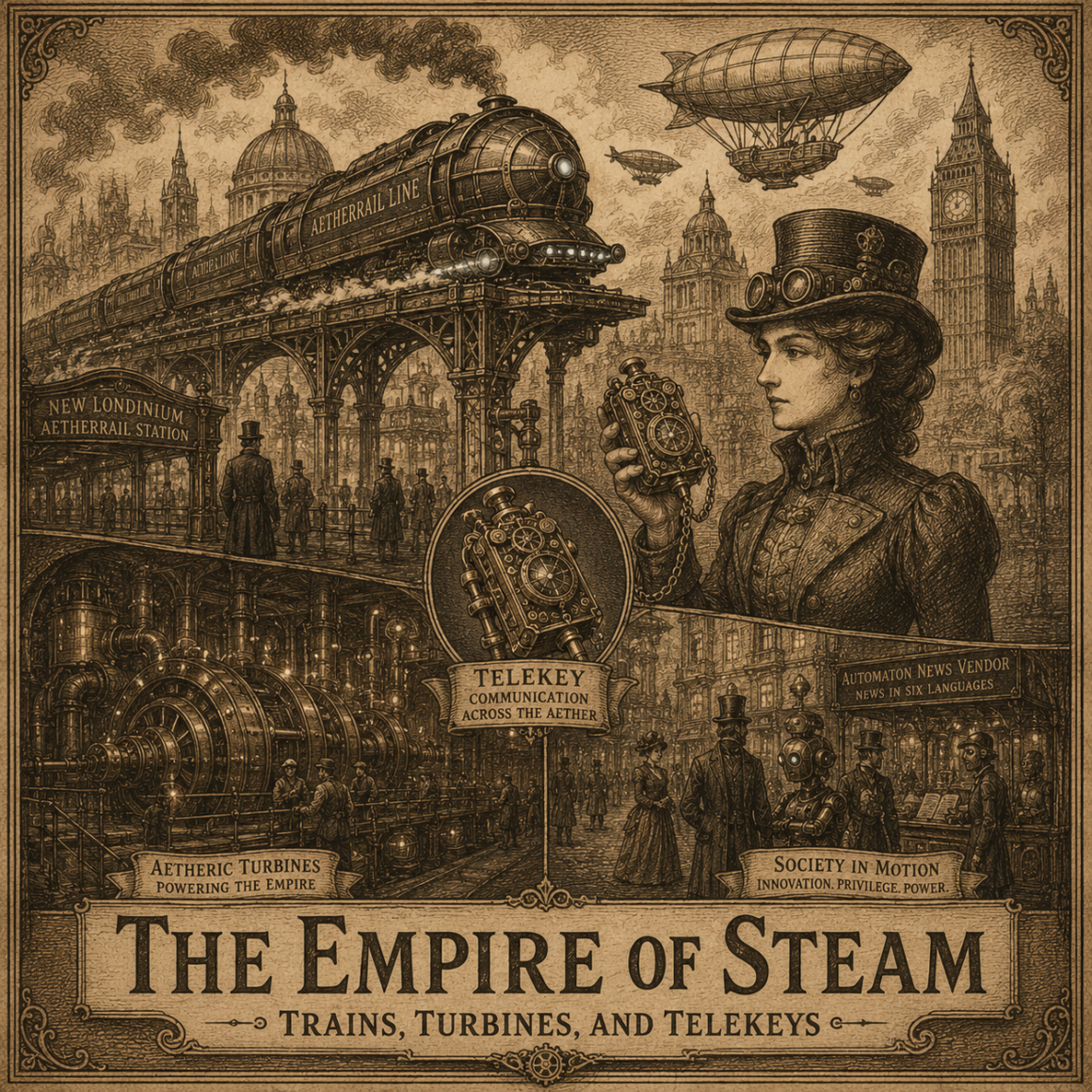
Gone were the clunky, coal-choked locomotives of the early 19th century. In their place roared the Aetherrail Lines—levitating trains that glided atop magnetic tracks, sparking with raw energy and cloaked in clouds of steam. These marvels ran from the domed stations of New Londinium to the frost-capped spires of Moscow-on-Thames, ferrying nobles, spies, and skyship engineers across the Empire at unmatched speed.
Beneath the surface, vast turbine networks powered entire cities, deep within mechanized caverns lit by glowing brass fixtures. These Aetheric Turbines spun day and night, humming with pressure, each one the size of a cathedral. Their rhythmic thrum echoed through the Empire like a mechanical heartbeat.
Communication, too, had evolved. In an age before radio and long before the telephone, the Empire relied on Telekeys—personal encryption devices powered by miniature steam cores and Aetherium nodes. With a flick of a switch and a dial of gears, messages could be sent across the aether lines to mirrored devices, transmitted in bursts of pressurized pulses. A telekey wasn’t just a communication tool—it was a symbol of power, rank, and privilege. Nobles wore theirs on ornate chains, while spies had theirs hidden in belt buckles and brooches.
Street corners bustled with automaton vendors shouting the news in six languages. Households owned cleaning drones built of lace-trimmed copper and ivory gears. Schools taught young minds to read blueprints before books. And from the spires of Oxford-Aether Academy, dirigibles the size of cricket fields carried students aloft to floating lecture halls suspended by gas and grace.
These weren’t the fantastical whims of fiction—they were the daily instruments of survival and supremacy.
But in the shadow of invention came inequality. The upper crust of society thrived in tower-top palaces filled with whispering tech, while the poor choked on soot below, relegated to repair, refuel, and reset the machines that ran their lives. Inventions built hope and horror in equal measure.
As we peer deeper into this world, we must ask: Are these wonders a testament to progress—or the gilded shackles of control?

You May Also Like
Here’s a list of upcoming steampunk events from late 2024 through 2025:
Exploring the Captivating World of Steampunk